
The real, festering wound of modern society doesn’t live in the caste where a person sits, but in the anxiety of movement between them—in that terrifying split where external status says one thing, and the inherited alarm in the flesh growls another. The class migrant carries two body languages inside, and neither is his mother tongue: bought peace on the skin, transgenerational hunger in the bones.
Remember that gap. We will return to it in the heart of the book, because in it—and not in any neat display case—lies the true, incurable patient. And who am I to speak of that gap with such bold certainty? Because I live in it. Because I am that corridor. And before I open you, it is fitting that you see the lineage that brought me to this icy table—and believe me, it will not be pleasant for you to watch.
TERRARIUM · CHAPTER 0 · SECTION V
A satire of class, written on the body.Your body chose its caste long ago. The waiter sees it. Your boss sees it. Everyone in the room sees it. Except you.
Arrives by email within minutes
We have climbed above the basement, and the surface beneath our feet has changed. There is no more clay, no damp synthetics, no grease; we are stepping on linoleum and a cheap, thin office carpet. The air smells of ozone from the photocopier, of a wilted plastic fern in the corner, and of the stale air of a room where the windows have a key, so they are opened only by someone who has authorization. Up here, no one yells anymore, and no one sweats out loud—more precisely, sweating here is prohibited by memorandum as a sign of a lack of professionalism. Panic here is quiet, starched, and perfectly buttoned up in polyester.
Welcome to the cage that you were, I am convinced, raised to consider a success.
They are called the Lower-Middle Class. In polished, statistical corporate reports, they are your administration, your clerks, junior analysts, call center operators, bureaucrats whose only job in this world is to translate someone else’s chaos into a neat, impenetrable procedure. Unlike the floors below, which tremble before bare survival, these people tremble before something much subtler and much more terrifying: they tremble before the regulation. For them, a rule is not a tool they use, a rule is the floor on which they stand; if you take away the rule, what opens beneath them is not freedom, but an abyss from which they have been fleeing all their lives.
Here too, the body is projected as a form. A shirt bought on discount, ironed so flawlessly that you can cut yourself on the edges of the sleeves—not because they love order, but because a crease on the collar is a piece of data someone can use against them. Posture upright, but tense, shoulders permanently raised to the ears as in perpetual expectation of a phone call bringing an audit. A watch that does not measure time, but the measurability of their performance. And a smile—turned on without a switch, flat, pleasant, calibrated to the exact temperature at which the client won’t rebel, and the boss won’t suspect. Nothing on that body is accidental. Everything is a report. And exactly because of that, that body is ghost-like and overstrained—a machine that starches itself into politeness every morning just so it wouldn’t have to feel how much its guts cramp from fear.
A pupil on patrol. It circles the room, counts the latecomers, and returns to the screen before anyone noticed it had left. You see diligence in that look. You see the employee of the month. I hear the bare, limbic alarm of a mammal that is locked in a cage with a predator and knows that its only salvation is to become invisible, to blend in with the color of the wall, to become the rulebook itself so that no one notices it.
Stop. What you enviously call stability, on this table is called lifelong, voluntary contractual slavery.
This man is not freer than the worker at the bottom. He is only quieter. The difference between his peace and the peace of a healthy man is the same as the difference between a room that has gone quiet and a room where everyone is whispering because there is a listening device in the wall. He does not respect the rule because he evolved into a highly moral being; he worships the rule because it is his only armor against the mud beneath him. His terror is not a fall into poverty—his terror is a fall back into sweat. He would rather consent to a styrofoam cage, to eight air-conditioned in which even his breath is normed, than to a bare palm that can be seen. And that obedience of his is not a virtue he hides—it is the commodity he sells, the most expensive product on his balance sheet.
Here I will let you neither admire him nor mock him. I know that cage from the inside, down to the last seam on the cheap blazer. I was raised exclusively by instruction, so I obeyed it, and for years I translated life into spreadsheets, people into objects, my own chaos into a neat, radiant construction that I managed from above like the architect of someone else’s house. I know exactly what it looks like when procedural correctness is the only ground beneath your feet because you actually have no ground beneath your feet, so you make an altar out of every contract.
But here is the single, crucial difference, and it is not in the mechanism—the mechanism is the same cage. The difference is what the cage serves for. To the bureaucrat, the cage is a refuge: he built it out of scarcity, to hide inside and so that no one from above sees him. To me, the cage was scaffolding: I built it out of nothing, over a bottomless chasm, not to stay in it, but so as not to shatter until I cross the room. He fell asleep in the cage. I was only fleeing through it. And it is exactly this difference, and not any merit of mine, that makes me capable of breaking apart this styrofoam of his for you, because I know exactly where it snaps.
Popeli smo se iznad podruma, i pod nogama nam se promijenila podloga. Nema više gline, nema vlažne sintetike, nema masti; gazimo po linoleumu i jeftinom, tankom uredskom tepihu. Zrak miriše na ozon iz fotokopirnog aparata, na uvenulu plastičnu paprat u kutu i na ustajali zrak prostorije u kojoj prozori imaju ključ pa ih otvara samo onaj tko ima ovlaštenje. Ovdje gore više nitko ne viče, i nitko se ne znoji naglas – točnije, znojenje je ovdje zabranjeno memorandumom kao znak manjka profesionalizma. ‘Panika je ovdje tiha, uštirkana i savršeno zakopčana u poliester’.
Dobro došli u kavez koji ste, uvjerena sam, odgojeni smatrati uspjehom.
Zovu ih Lower-Middle Class. U ulickanim, statističkim izvještajima korporacija oni su vaša administracija, vaši referenti, mlađi analitičari, operateri u pozivnim centrima, činovnici čiji je jedini posao na ovom svijetu da tuđi kaos prevedu u urednu, neprobojnu proceduru. Za razliku od katova ispod, koji drhte pred golim preživljavanjem, ovi ljudi drhte pred nečim mnogo suptilnijim i mnogo strašnijim: drhte pred propisom. Za njih pravilo nije alat kojim se služe, pravilo je pod na kojem stoje; makneš li im pravilo, pod njima se ne otvori sloboda, otvori se ponor iz kojeg bježe cijeli život.
I tijelo se ovdje projektira kao obrazac. Košulja kupljena na popustu, izglačana tako besprijekorno da se na rubovima rukava možeš porezati – ne zato što vole red, nego zato što je nabor na ovratniku podatak koji netko može upotrijebiti protiv njih. Držanje uspravno, ali napeto, ramena trajno podignuta prema ušima kao u vječnom iščekivanju telefonskog poziva koji donosi reviziju. Sat koji ne mjeri vrijeme, nego mjerljivost njihova učinka. I osmijeh – upaljen bez prekidača, ravan, ugodan, ‘baždaren’ na točno onu temperaturu na kojoj se klijent neće pobuniti, a šef neće posumnjati. Ništa na tom tijelu nije slučajno. Sve je izvještaj. I baš zato je to tijelo sablasno prenapregnuto – stroj koji svako jutro sam sebe utegne u pristojnost samo da ne bi morao osjetiti koliko mu se utroba grči od straha.
Zjenica na ophodnji. Obiđe sobu, izbroji zakašnjenja, vrati se na ekran prije nego što je itko primijetio da je izašla. Vi u tom pogledu vidite marljivost. Vidite zaposlenika mjeseca. Ja čujem goli, limbički alarm sisavca koji je zaključan s predatorom i zna da mu je jedini spas postati nevidljiv, stopiti se s bojom zida, postati sam pravilnik kako ga nitko ne bi primijetio.
Stanite, vi ovo zavidno zovete stabilnošću, na ovom se stolu zove doživotnim, dobrovoljnim ropstvom pod ugovorom.
Ovaj čovjek nije slobodniji od radnika na dnu. On je samo tiši. Razlika između njegova mira i mira zdrava čovjeka ista je kao razlika između utihnule sobe i sobe u kojoj svi šapću jer je u zidu prisluškivač. On ne poštuje pravilo jer je evoluirao u visoko moralno biće; on pravilo obožava jer mu je ono jedini oklop protiv blata ispod njega. Njegov užas nije pad u siromaštvo – njegov je užas pad natrag u znoj. On radije pristaje na kavez od stiropora, na klimatiziranih osam sati u kojima mu je i udah normiran, nego na goli dlan koji se vidi. I ta njegova poslušnost nije vrlina koju krije – to je roba koju prodaje, najskuplji proizvod u njegovoj bilanci.
Ovdje ne dam da mu se ni divite ni da mu se rugate. Taj kavez poznajem iznutra, do posljednjeg šava na jeftinom sakou. Odgojila me isključivo uputa, pa sam je poslušala i godinama život prevodila u tablice, ljude u predmete, vlastiti kaos u urednu, blistavu konstrukciju kojom sam upravljala odozgo kao arhitekt tuđe kuće. Znam točno kako izgleda kad je proceduralna ispravnost jedino što te drži da ne propadneš, pa od svakog ugovora praviš oltar.
Ali evo jedine, presudne razlike, i ona nije u mehanizmu – mehanizam je isti kavez. Razlika je čemu kavez služi. Činovniku je kavez utočište: sagradio ga je iz oskudice, da se sakrije unutra i da ga odozgo nitko ne vidi. Meni je kavez bio skela: sagradila sam ga iz ničega, nad procjepom bez dna, ne da u njemu ostanem nego da preživim tu jednu sobu čitava. On je u kavezu zaspao. Ja sam kroz njega samo bježala. I baš me ta razlika, a ne nikakva moja zasluga, čini sposobnom da vam ovaj njegov stiropor razlomim, jer znam točno gdje puca.
Dusevic, E. (2026). Terrarium: Castes of the body—A satire of class, Chapter 4, Section I.
Sociology · Spiral Dynamics · Neurobiology
Author's note
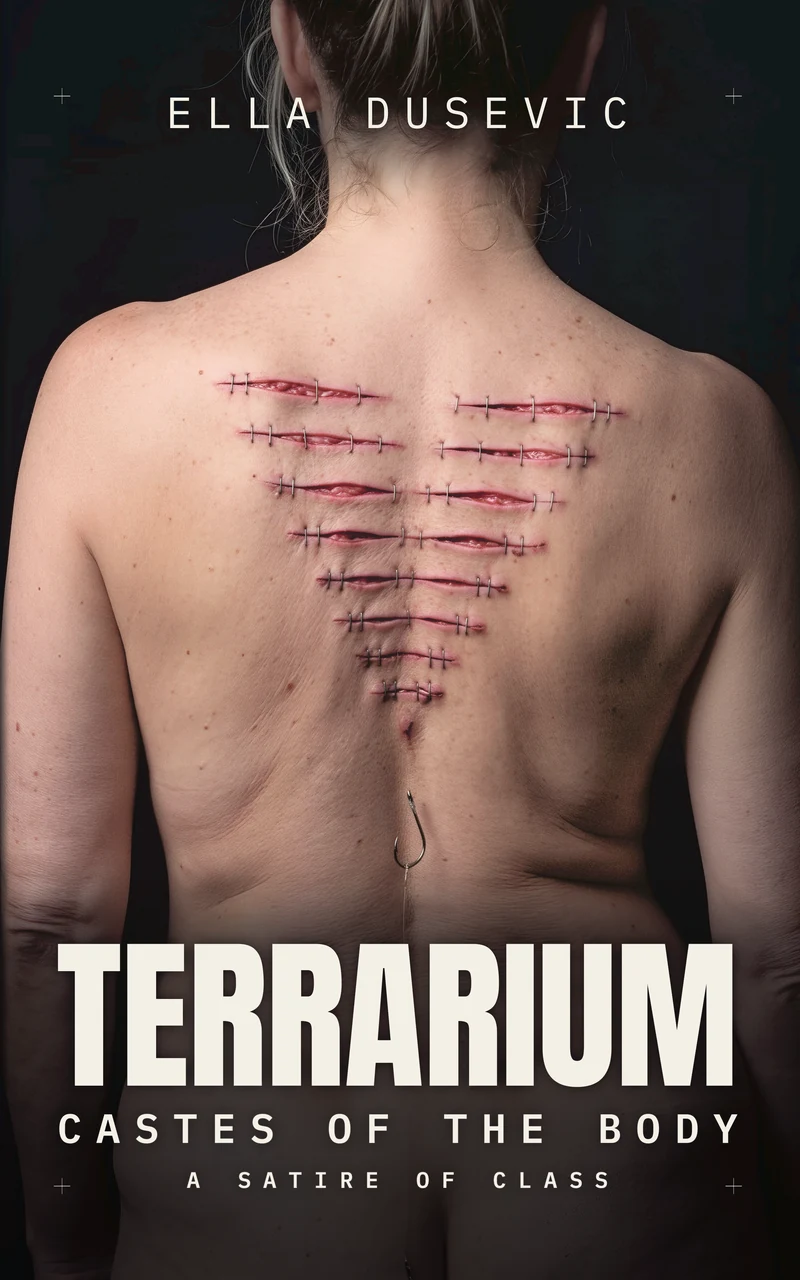
This is a hybrid that asks no permission from any discipline: a clinical dissection that smells of formalin, prose that bleeds, and a manual that betrays its own genre on every page. The theory beneath it does not lie: sociology, Spiral Dynamics, and neurobiology, verified down to the last source, then taken apart by my own hand, fiber by fiber, and reassembled into an anatomy that did not exist before. Its nine floors climb nowhere; they sink, with impeccable manners, toward a hook beneath the lowest cut—a hook that never needed bait, because the body is the bait.
I offer no comfort and I do not heal; there are more patient trades than mine for that. This book was written for everyone, but for many it will land like a scalpel, because it is a mirror that shows no mercy to whoever stands in front of it, and it shows the mechanics of survival exactly as they work—wet, persistent, still twitching. You enter this terrarium knowingly, your face pressed to the glass, certain you are watching the specimen—and the specimen is you. At your own risk.
The author
For thirty years she tailored—for other people’s bodies and for her own face—and from that side of the spotlight, better than from any seat in the house, one sees the illusion sweat and the body change its clothes in panic a second before the lights come up. It was her laboratory without an ethics board. The audience she once fed with magic she now, with the same deft fingers, undresses.
When the light stopped explaining anything, she went into science: psychology gave her the apparatus, sociology the address. Out of that she built something for which the discipline keeps no compartment: a cold map of how hierarchy and capital are written straight into the nervous system. The book is neither a manual nor prose, but an object that refuses both names.
She would not drag the manuscript through academic censorship or editorial compromise, so she published it herself—as it is, without anesthesia.
File
The same preparation in several forms: read, heard, held in the hand until it warms under your fingers — the active substance does not change. Dispensed without prescription.
Forms · English
Forms · Croatian
Side effects not listed. The patient leaflet is the book.